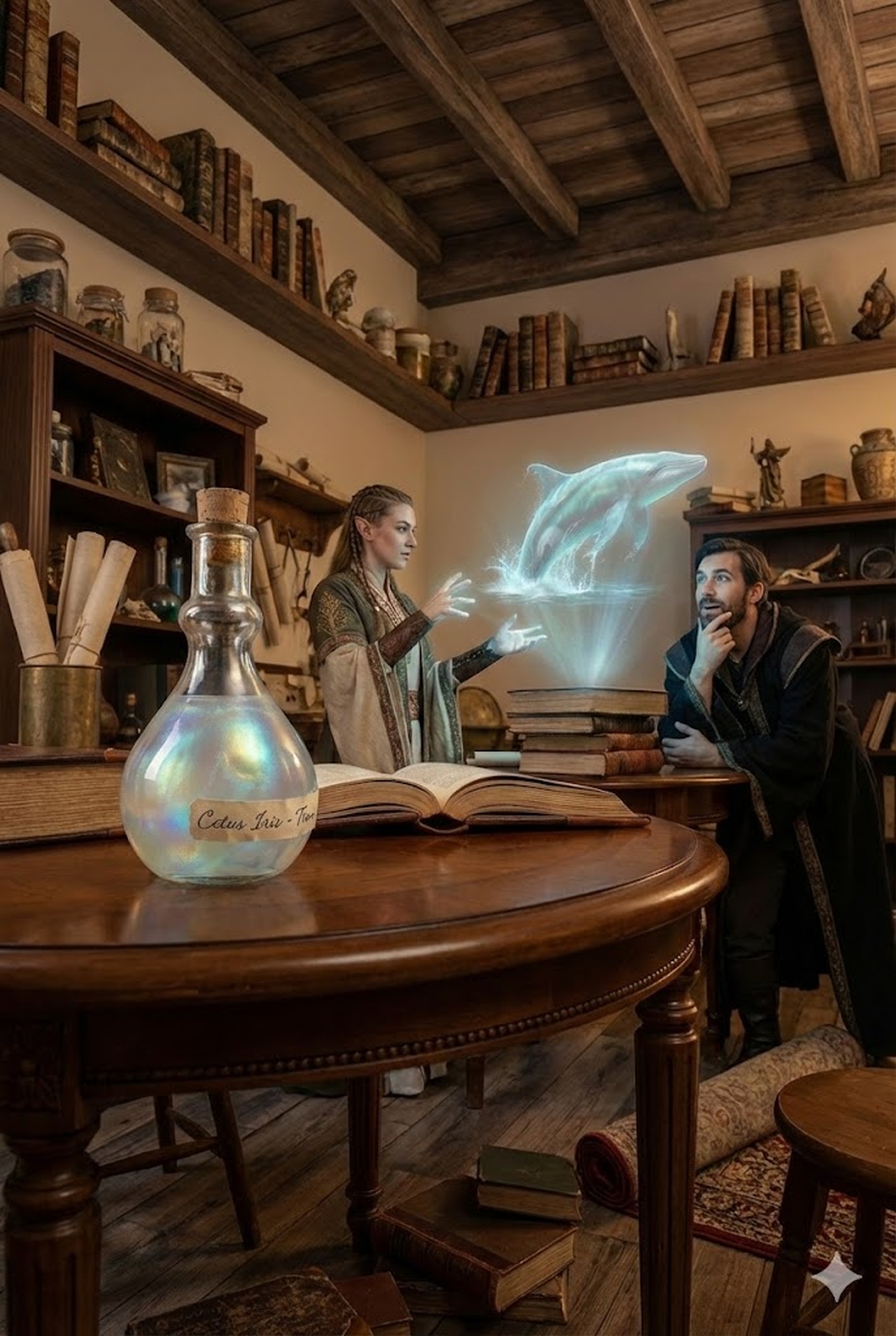
The blubber, the fatty tissue under the skin, is the reason why these majestic animals are hunted. It is no ordinary fat, but a storehouse of magical energy.
In its raw state, blubber is a tough, jelly-like mass that glows faintly blue. After refinement (melting and filtering), it becomes a clear, oily elixir that streaks like liquid mother-of-pearl. Unlike the rancid blubber of ordinary whales, the blubber of the Schiller whale smells fresh, salty, and slightly metallic (like the air before a thunderstorm).
It is the best known means of binding volatile magic in potions (see Elixir of the Elven Watch).
When burned in lamps, it gives off a light that never produces soot and can make the invisible visible. Weapon oils made from this oil can injure spirits.
Since hunting them is extremely dangerous (iridescent whales rarely defend themselves, but are often protected by sea elementals or mermaids) and the animals are rare, the price is enormous.
The Ancatir consider hunting iridescent whales a sacrilege. They only use oil that comes from whales that have washed ashore naturally (“gift of the tides”). Alchemists who use “bloody oil” are often expelled from the city in elven enclaves.
The Schiller whale is one of the most fascinating and peace-loving giants of the seas around Tirakan. It is not just an animal, but a living anomaly closely connected to the magical currents of the oceans.
The iridescent whale resembles an earthly blue whale in shape, but is slimmer and has longer, almost wing-like side fins. What makes it special is its skin: it is not gray, but has a pearlescent, semi-transparent surface. Depending on the incidence of light and the magical saturation of the environment, its skin refracts light into all colors of the spectrum. Hence the name. When a iridescent whale breaks the surface, it looks like a living rainbow rising out of the water. Scholars believe that these whales not only feed on krill, but also absorb the light of the moon and stars when they come to the surface at night.
Iridescent whales avoid shallow coastal waters. They travel through the deep oceans, far away from the routes of merchant ships.
They are most often sighted in the Southern Ocean, in the cold currents far from the heat of the jungle, or in the mystical waters around abandoned island archives.
They travel in small family groups (pods). It is said that their song can calm storms or drive madness in those who listen to it for too long.
"We saw it at new moon. It glowed beneath the keel like a sunken city. When we threw the harpoons, the beast did not scream. It began to sing. A sound so deep that the wood of my ship splintered and two of my men simply jumped into the water, smiling. We killed it, yes. But the oil... it burns in the lamps of my cabin, and I swear I see the faces of those who jumped in the shadows."* From the logbook of the whaler 'Haken-Ulf'